Islamic Thought and Social Theory: A Ghazalian Approach
By Admin on Jan 19, 2026 213x dibaca
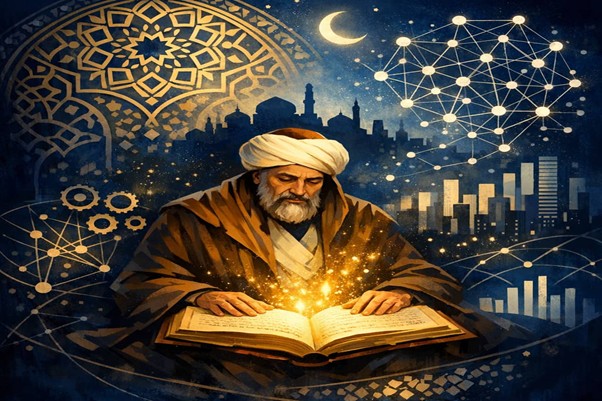
The relationship between Islamic thought and social theory has long been characterised by a complex negotiation between normative religious commitments and analytical frameworks largely shaped by modern Western intellectual traditions. While contemporary social theory often privileges empirical observation, structural explanation, and secular rationality, Islamic intellectual traditions have historically grounded social understanding in ethical, metaphysical, and theological assumptions. A Ghazalian approach provides a distinctive framework through which this tension can be productively explored, not by rejecting modern social theory, but by critically re-embedding it within a moral and epistemological vision rooted in Islamic thought.
Abū Ḥāmid al-Ghazālī occupies a pivotal position in the Islamic intellectual canon precisely because of his sustained engagement with competing modes of knowledge. His critique of the philosophers in Tahāfut al-Falāsifah and his careful appropriation of logic and rational inquiry demonstrate a nuanced epistemological stance that resists both uncritical rationalism and anti-intellectual fideism. From a Ghazalian perspective, reason is indispensable, yet intrinsically limited; it requires ethical discipline and spiritual orientation in order to function properly. This epistemological modesty stands in contrast to dominant strands of modern social theory that assume the sufficiency of human reason to explain and organise social life.
In applying Ghazalian insights to social theory, the first major contribution lies in rethinking the foundations of social knowledge. Modern social theory often presumes a sharp distinction between facts and values, treating moral considerations as secondary or external to social analysis. A Ghazalian approach challenges this separation by insisting that ethical values are constitutive of social reality rather than merely reflective of it. Concepts such as justice (ʿadl), trust (amānah), and public interest (maṣlaḥah) are not abstract ideals imposed upon society from above, but operative principles that shape social relations and political legitimacy.
This ethical orientation has profound implications for political theory within Islamic thought. Discussions of governance in Muslim societies have frequently oscillated between idealised models derived from early Islamic history and pragmatic accommodations to modern nation-state structures. A Ghazalian approach reframes this debate by focusing on the moral purpose of political authority rather than its formal configuration. Political institutions, from this perspective, are judged not solely by their conformity to procedural norms, but by their capacity to cultivate justice, restrain tyranny, and promote moral responsibility among both rulers and citizens.
In contemporary debates on democracy, this perspective offers a critical intervention. Democracy is often presented either as a universal solution to political dysfunction or as a foreign imposition incompatible with Islamic values. A Ghazalian approach avoids both extremes by treating democracy as a morally contingent practice rather than an inherently virtuous system. Democratic mechanisms such as consultation, representation, and accountability are valuable insofar as they serve ethical ends. Where they devolve into mere instruments of power or popular desire unchecked by moral restraint, their legitimacy becomes questionable. This ethical critique does not undermine democratic participation but deepens it by situating political agency within a framework of moral self-governance.
Beyond political institutions, Ghazalian thought contributes to social theory through its sophisticated account of the human self. Al-Ghazālī’s analyses of intention (niyyah), desire, and moral struggle anticipate modern concerns with subjectivity and agency. Whereas structuralist approaches in social theory tend to emphasise impersonal forces such as economic systems or bureaucratic rationality, a Ghazalian approach insists on the centrality of moral agency in social life. Social transformation, from this perspective, cannot be achieved solely through institutional reform; it also requires ethical cultivation and the reorientation of individual and collective desires.
This emphasis on moral psychology enables a more comprehensive understanding of social cohesion and moral breakdown. Al-Ghazālī’s discussions of hypocrisy, corruption, and moral blindness provide valuable analytical tools for diagnosing contemporary social pathologies, particularly in contexts marked by formal religious commitment but pervasive injustice. By integrating ethical introspection with social critique, a Ghazalian approach bridges the gap between personal morality and structural analysis, a divide that has often limited the explanatory power of modern social theory.
Furthermore, engaging social theory through a Ghazalian lens encourages a critical stance towards secularism as an unquestioned epistemological norm. Rather than advocating a theocratic model, this approach calls into question the assumption that social rationality must be detached from metaphysical commitments. In doing so, it opens space for a pluralistic intellectual landscape in which religiously informed social theories can participate as legitimate interlocutors. This is particularly relevant in global academic contexts where non-Western epistemologies continue to be marginalised.
Ultimately, Islamic Thought and Social Theory: A Ghazalian Approach represents an attempt to articulate a mode of critical engagement that is both rooted and dialogical. It resists nostalgic appeals to an idealised past while remaining sceptical of unexamined modernity. By drawing on the ethical depth and epistemological humility of Ghazalian thought, this approach offers a robust framework for analysing contemporary social and political challenges in Muslim societies and beyond. It affirms that Islamic intellectual traditions, when critically re-engaged, remain capable of contributing meaningfully to ongoing debates in social and political theory, not as peripheral voices, but as sources of conceptual innovation and moral insight.
Oleh : Mamdukh Budiman
Student PhD Islamic Studies